
01 · Overview
The short version
Asthma can show up as cough, tightness, wheeze, or shortness of breath
Not everyone has the same mix of symptoms, and some people mainly notice cough at night or with exercise.
Triggers are personal and can change
Smoke, cold air, infections, dust mites, mold, pets, pollen, chemicals, and workplace dust can all play a role, but not every trigger affects every person.
Treatment often has two parts
Quick-relief medicine helps during symptoms, while controller medicine lowers airway inflammation and helps prevent flare-ups.
Severe breathing trouble is an emergency
If rescue medicine is not helping, the person cannot speak in full sentences, or lips or face look blue or gray, call 911 right away.
02 · Care guidance
When to get help
Emergency help
- Call 911 or local emergency services now if breathing is severely difficult, lips or face look blue or gray, the person cannot speak in full sentences, or rescue medicine is not helping during a serious attack.
- Get emergency help right away if severe breathing symptoms are getting worse quickly or the person seems too short of breath to finish a sentence.
Get advice promptly
- Contact a clinician soon if asthma symptoms are happening more often, you are waking at night with cough or wheeze, you need rescue medicine more than expected, or exercise keeps triggering symptoms.
- Get prompt medical advice if symptoms may be asthma but the diagnosis is not clear, especially in a child or during pregnancy. If you also have chest pain, a significant fever, or you seem to have a new infection, seek urgent medical assessment because it may be something other than asthma.
Arrange a non-urgent visit to review whether your asthma is controlled, whether inhaler technique is correct, and whether your trigger plan or medicines need updating.
03 · Asthma
What asthma does to the airways
Asthma is a long-term airway problem, not just an occasional cough.
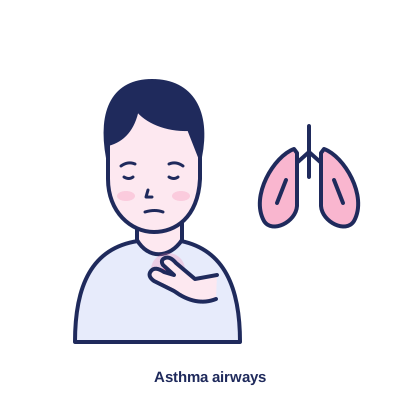
Asthma is a chronic lung disease that affects the airways, the tubes that carry air in and out of the lungs. When those airways become inflamed and narrowed, breathing can feel tight, noisy, or harder work than usual. Symptoms may be mild on some days and much worse during a flare-up.
The same condition can look different from one person to another. Some people notice wheezing, while others mainly have cough, chest tightness, or shortness of breath. The pattern matters because asthma often comes and goes instead of staying constant.
- Asthma can be present even when symptoms are not happening at the moment.
- A flare-up may build slowly or begin suddenly.
- Symptoms alone do not prove asthma, so history and testing matter.
04 · Asthma
Signs that point toward asthma
Wheeze is common, but asthma can also show up as cough, chest tightness, or shortness of breath.
The main symptoms are wheezing, coughing, chest tightness, and shortness of breath. Many people notice cough at night or early in the morning. Children may also seem tired, irritable, or have trouble eating when symptoms are bad.
Wheezing is the classic sound people expect, but asthma does not always make a whistling noise. Some people mainly feel like they cannot get a full breath, and others notice that symptoms show up with exercise or after exposure to a trigger.
- Nighttime cough can be an important clue.
- Exercise-related symptoms should not be brushed off.
- Symptoms can range from mild to severe.
05 · Asthma
Triggers that can set off symptoms
The most useful clue is a repeated pattern, not one isolated exposure.
Asthma triggers can include tobacco smoke, cold air, outdoor air pollution, infections such as colds and flu, exercise, dust mites, mold, pets, pollen, pest waste, household chemicals, certain medicines, and workplace dusts or chemicals. Triggers can be different for each person and can change over time.
A trigger is not a diagnosis by itself. For example, coughing after mold exposure could fit asthma, an allergy, or another respiratory problem. What matters is whether the same exposure keeps bringing symptoms back and whether symptoms improve when the exposure is reduced.
- Allergic triggers include dust mites, mold, pets, pollen, and pest waste.
- Nonallergic triggers include cold air, smoke, chemicals, and infections.
- Workplace dusts or chemicals can be part of the story in adults.
06 · Asthma
How asthma is checked in a visit
Doctors usually combine symptoms, exam findings, and breathing tests.
A clinician may suspect asthma from your symptoms and exam, then use tests such as spirometry, peak expiratory flow, or fractional exhaled nitric oxide testing to see how well the lungs are working and whether inflammation is present. If allergies seem to play a role, allergy skin or blood tests may also help.
In children, diagnosis can be harder because young children may not be able to do breathing tests reliably. A clinician may look closely at the pattern of symptoms, ask about school, sleep, eating, and activity, and sometimes try asthma medicine for a period of time to see whether symptoms improve.
- Bring a list of symptoms, triggers, and timing.
- Tell the clinician if symptoms are worse at night or with exercise.
- Share whether a child is missing school, eating poorly, or waking up coughing.
07 · Asthma
What asthma medicines are meant to do
Quick relief and long-term control are different jobs.
Asthma treatment often includes quick-relief medicine for symptoms and controller medicine to lower airway inflammation and help prevent attacks. The exact plan depends on how often symptoms happen, how severe they are, and how much risk there is for flare-ups.
Using a rescue inhaler more often than expected can mean asthma is not well controlled. Do not change or stop prescribed medicine on your own. If symptoms are increasing or a rescue medicine does not seem to help, the treatment plan needs review.
- A rescue inhaler is meant for symptom relief, not as the whole plan.
- Controller medicine is about prevention.
- A written action plan helps you know what to do when symptoms worsen.
08 · Asthma
When the problem may be something else
Wheezing and shortness of breath are not unique to asthma.
Allergies, respiratory infections, inhaled irritants, and some other lung or airway problems can cause similar symptoms. In adults, chronic cough can also come from reflux, postnasal drip, medication side effects, or smoking-related lung disease. The point of evaluation is to match treatment to the real cause, not to assume every cough or wheeze is asthma.
Sudden severe breathing trouble, chest pain, fainting, a high fever, or symptoms that look very different from a usual flare-up should not be treated as routine asthma. Those features can mean another condition is present and may need urgent care.
- A history of allergies does not automatically mean asthma.
- New or unusual symptoms deserve reassessment.
- Some breathing problems are emergencies even if asthma is also possible.
09 · Asthma
Asthma in children and over time
Children can outgrow the pattern for a while, but symptoms can return later.
Asthma often starts during childhood, sometimes before age 5. It can look like repeated colds, coughing at night, fast breathing, trouble eating, or unusual tiredness or irritability. Because young children may not describe their breathing well, caregivers often have to watch for pattern changes.
Some children have fewer symptoms as they grow, while others continue to have asthma into adolescence or adulthood. Even when things seem better, asthma can return, so periodic review of symptoms and medicine needs still matters.
- Caregivers should know the child’s action plan.
- School or daycare staff may need instructions too.
- Severe coughing, serious breathing trouble, or blue lips or fingernails need immediate help.
10 · FAQ
Questions people ask
Can asthma happen without wheezing?
Yes. Some people mainly have coughing, chest tightness, or shortness of breath, especially at night or with exercise. Wheeze is common, but its absence does not rule out asthma. A clinician may use history and breathing tests to sort it out, and urgent care is needed if breathing becomes severe or rapidly worse.
Is exercise supposed to trigger asthma?
Exercise can trigger symptoms in some people, especially in cold, dry air, but that does not mean you should avoid all activity. Many people stay active with the right treatment and a plan. If exercise regularly causes symptoms, the safer next step is to review control and triggers with a clinician.
Why does my asthma get worse at night?
Nighttime symptoms can happen because of airway inflammation, mucus, allergies, or triggers in the bedroom such as dust mites or pet dander. Waking up coughing or wheezing more than once can be a sign your asthma is not well controlled and should be reviewed, especially if rescue medicine is needed more often.
Do children outgrow asthma?
Some children have fewer symptoms as they get older, while others continue to have asthma into the teen years or adulthood. Even when symptoms improve, asthma can return later. Because patterns change, children still need periodic review of symptoms, triggers, and medicine needs.
Should I treat every cough as asthma?
No. Cough can come from colds, allergies, reflux, postnasal drip, smoking-related lung disease, or medication side effects, as well as asthma. The pattern and timing help sort it out. If the cough is new, severe, or comes with chest pain, fever, or trouble breathing, get evaluated rather than assuming it is asthma.
11 · References
References and supporting evidence
These sources support the points identified below. Source checking is not clinical approval.
- S1: AsthmaMedlinePlus / U.S. National Library of Medicine
Explains that asthma is a long-term airway disease and describes the basic airway narrowing and inflammation that can cause symptoms.
- S2: Asthma in ChildrenMedlinePlus / U.S. National Library of Medicine
Explains that asthma commonly begins in childhood and that children may need age-appropriate assessment and follow-up.
- S3: AllergyMedlinePlus / U.S. National Library of Medicine
Explains that allergies can overlap with asthma symptoms and that allergy patterns may help a clinician consider another or additional cause.
General information, not a diagnosis. This guide is not a substitute for care from a qualified healthcare professional. For an emergency, call 911 in the US or your local emergency number. Illustrations are conceptual and are not diagnostic images.