
01 · Overview
The short version
The location alone does not tell the cause
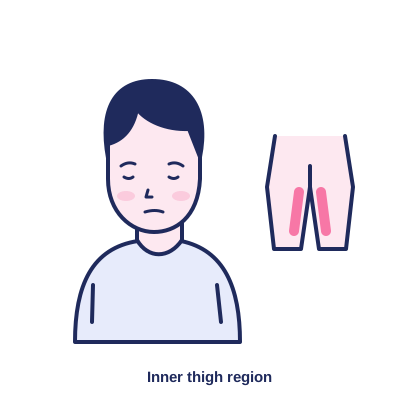
Inner thigh pain can come from the adductor muscles, the hip joint, the groin, the pelvis, or a nearby nerve. The same area can feel sore, sharp, burning, or crampy.
Movement patterns give useful clues
Pain that worsens with squeezing the legs together, running, or quick direction changes often fits a muscle or tendon problem. Burning, tingling, or numbness points more toward nerve irritation.
Swelling and redness change the urgency
One-sided swelling, warmth, redness, fever, or a heavy leg can signal a clot or infection and should not be treated like ordinary soreness.
Persistent pain deserves an exam
If pain lasts more than a few days, keeps returning, limits walking, or is linked to hip, knee, urinary, testicular, or pelvic symptoms, a clinician needs to sort out the source.
02 · Care guidance
When to get help
Emergency help
- Call 911 or local emergency services now if inner thigh pain comes with chest pain, shortness of breath, fainting, sudden severe weakness, or stroke symptoms.
- Get emergency care right away for sudden testicular pain, severe abdominal pain, severe pelvic pain, or possible ectopic pregnancy.
- Seek urgent help for severe pain after a fall, sports injury, or accident, especially if you cannot bear weight or the leg looks deformed.
- Get immediate emergency care for a hot, swollen leg with pain and redness if breathing symptoms happen too.
Get advice promptly
- Seek urgent same-day assessment for new one-sided leg pain with swelling, warmth, or redness, especially after surgery, prolonged immobility, pregnancy, or hormone use. Do not wait a day or two for suspected DVT.
- Contact a clinician promptly if the pain lasts more than a few days, keeps returning, limits walking, or is not improving with rest.
- Make an appointment soon if you notice numbness, tingling, a groin bulge, pain with urination, pain in the hip or knee, or pain that wakes you from sleep.
- Arrange care sooner if the pain is getting worse instead of better, or if you are unsure whether the problem is muscle, hip, nerve, or groin-related.
If the pain is mild, you can still move normally, and there are no red flags, short-term activity changes and simple self-care are reasonable. If it does not clearly improve, a clinician can help decide whether the source is muscle, tendon, joint, nerve, or something else.
03 · Inner Thigh Pain
Reading the pain pattern before guessing the cause
Inner thigh pain is a symptom with several possible sources, and the way it feels often gives the first clue.
The inner thigh sits close to the adductor muscles, the hip joint, the groin, the pelvis, and several nerves. That is why the same spot can hurt for very different reasons. A person may feel a deep ache, a pulling pain, a sharp stab, a burn, or a cramp in the same area.
The pattern matters as much as the location. Pain after exercise or a sudden movement often fits a muscle or tendon problem. Pain that burns, tingles, or feels numb is more suggestive of nerve irritation. Swelling, warmth, or redness makes a clot or infection more concerning than a simple strain.
- Pain after running, kicking, or quick turns often points toward the adductor muscles.
- Burning, buzzing, tingling, or numbness is less typical of a plain strain.
- A heavy, warm, red, or swollen leg needs faster assessment.
04 · Inner Thigh Pain
When a strain or tendon injury is the likely fit
Adductor strain is a common reason for inner thigh pain after sports, overuse, or sudden direction changes.
The inner thigh muscles help pull the legs inward and steady the pelvis. They can be strained during running, kicking, skating, dancing, lifting, or fast changes in speed or direction. People often notice pain when they squeeze the knees together, stretch the leg outward, or climb stairs.
Tendon irritation can feel similar and may hang around if the area keeps getting reworked too soon. A more serious injury is more likely when the pain started with a pop, a sudden sharp pull, bruising, weakness, or trouble walking. Those signs do not prove a tear, but they do make a routine workout ache less likely.
Short-term rest from the activity that triggered the pain usually matters because repeated strain can keep the tissue irritated. Gentle, pain-limited movement is usually better than complete bed rest when the problem is a minor muscle injury.
- Pain with squeezing the knees together points toward the adductors.
- A pop, bruising, or clear weakness raises concern for a larger injury.
- Returning too quickly can keep a strain from settling down.
05 · Inner Thigh Pain
When the hip, groin, or abdomen is the real source
Pain felt in the inner thigh may start in the hip or groin, especially if it is deep, stiff, or linked to walking.
The hip joint can send pain into the groin, upper inner thigh, or even the knee. That is why pain with walking, stairs, turning the leg, or getting in and out of a car can mean the hip is part of the problem. A deep ache or catching feeling is often different from a surface muscle soreness.
A groin bulge or pressure sensation can point to a hernia, especially if it shows up with coughing, straining, or lifting. Pain from the pelvis or lower abdomen can also be felt in the inner thigh. Because these sources overlap, persistent or deep pain should be evaluated instead of labeled a simple strain without an exam.
- Deep groin pain is often not the same as a sore muscle.
- Hip pain may show up in the thigh or knee.
- A bulge that changes with coughing or lifting can suggest a hernia.
06 · Inner Thigh Pain
Burning, tingling, or numbness points in a different direction
Nerve irritation is more likely when the pain feels electric, hot, buzzing, or numb instead of simply sore.
Nerve pain may feel sharp, electric, hot, or oddly sensitive to touch. It can happen after prolonged sitting, repetitive movement, tight clothing, pregnancy, swelling, or pressure near the pelvis or low back. Some nerve problems stay in one small area, while others spread toward the groin, buttock, or knee.
What matters most is whether numbness, weakness, or a changing pattern comes with the pain. Those features make a plain muscle strain less likely and make an exam more useful, especially if the symptoms are not improving or seem to be spreading.
- Burning or buzzing is less typical of a strain.
- Numbness or weakness should not be ignored.
- Symptoms that worsen with sitting can fit nerve compression.
07 · Inner Thigh Pain
When swelling, redness, or fever changes the situation
One-sided swelling, warmth, redness, fever, or a heavy leg can mean a clot or infection and needs prompt evaluation.
A blood clot in the leg can cause pain, tenderness, swelling, or a heavy feeling, sometimes without a clear injury. This becomes more concerning when one leg is more swollen than the other, or when the area is red and warm. A clot can become dangerous if it travels to the lungs, which is why new leg swelling with pain needs urgent attention.
An infection in the skin or deeper tissues can also cause inner thigh pain, especially if the area is hot, red, and tender or if you feel sick or feverish. These problems are different from an overworked muscle. If the pain is getting worse instead of better, or the leg looks visibly changed, it should be checked quickly.
- One-sided swelling is more concerning than soreness alone.
- Warmth and redness are not typical workout symptoms.
- Fever with thigh pain should be assessed promptly.
08 · FAQ
Questions people ask
Is inner thigh pain usually a muscle strain?
Often, but not always. A strain is more likely after exercise, quick turns, or overuse, especially if the pain gets worse when you squeeze your legs together. Pain that burns, tingles, swells, or comes with fever may have a different cause and should not be treated like ordinary soreness.
Why does my inner thigh hurt when I walk?
Walking pain can happen with a muscle strain, hip problem, groin issue, or nerve irritation. The pattern matters. Pain with each step, stiffness after sitting, or pain that seems to come from the groin or knee can point away from a simple sore muscle and toward the hip or nearby structures.
Can sitting too long cause inner thigh pain?
Yes. Prolonged sitting can tighten irritated muscles, compress nerves, or worsen some hip and groin problems. If the pain also feels numb, burning, or buzzing, a nerve source becomes more likely and should be checked if it persists or keeps coming back.
When should I worry about a blood clot?
Be concerned if the pain comes with one-sided swelling, warmth, redness, tenderness, or a heavy feeling in the leg, especially after surgery, long travel, pregnancy, or hormone therapy. Seek prompt medical care because a clot can become an emergency if it moves to the lungs.
Does a hernia cause inner thigh pain?
It can. A hernia often causes groin pressure, discomfort with lifting or coughing, or a bulge that comes and goes. It is not the only cause of inner thigh pain, but a new bulge or strong groin pressure should be examined.
Can inner thigh pain come from the hip?
Yes. Hip problems commonly refer pain to the groin or inner thigh. Clues include stiffness, pain with turning the leg, pain climbing stairs, or trouble getting in and out of a car. Those symptoms are worth an exam because the hip may be the true source.
09 · References
References and supporting evidence
These sources support the points identified below. Source checking is not clinical approval.
- E1: DVT (deep vein thrombosis)National Health Service (NHS)
Explains why new one-sided leg pain with swelling needs urgent same-day assessment and why chest pain, breathlessness, or fainting are emergency signs.
- E2: Groin PainCleveland Clinic
Explains that inner thigh or groin-area pain can come from several body systems and that clinicians use history and examination to sort out the cause.
General information, not a diagnosis. This guide is not a substitute for care from a qualified healthcare professional. For an emergency, call 911 in the US or your local emergency number. Illustrations are conceptual and are not diagnostic images.