
01 · Overview
The short version
A swollen node is a clue, not a diagnosis
Lymph nodes are part of the body’s infection-fighting system. They can swell when the immune system is reacting to infection or inflammation, but the same symptom can also happen with other illnesses.
Where the swelling is matters
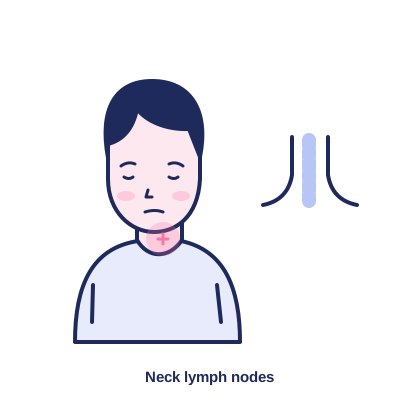
Neck, armpit, and groin nodes often respond to nearby problems such as a throat infection, skin irritation, a dental issue, or a sore on the leg or foot. Deep nodes, such as those in the chest, may cause fewer obvious clues and need medical evaluation.
Timing helps separate reassuring from concerning
A node that starts to shrink after a recent illness is more reassuring. Swelling that lasts, keeps growing, or comes with fever, night sweats, unexplained weight loss, or ongoing fatigue needs prompt assessment.
Breathing or swallowing trouble is an emergency
Get immediate help if swelling comes with trouble breathing, trouble swallowing, fainting, confusion, chest pain, or rapidly worsening weakness. Those symptoms matter more than the size of the node itself.
02 · Care guidance
When to get help
Emergency help
- Call 911 or go to the emergency room now if swollen lymph nodes come with trouble breathing, trouble swallowing, chest pain, fainting, confusion, severe weakness, or a rapidly worsening allergic reaction.
- Do not wait at home if the swelling is part of a fast-moving severe illness or you cannot safely swallow or breathe.
Get advice promptly
- Contact a clinician soon if the swelling lasts more than a few weeks, keeps enlarging, feels hard or fixed in place, is very painful, or comes with fever, night sweats, unexplained weight loss, rash, joint pain, or recent tick exposure.
- Get checked sooner if more than one area is swollen, if you also feel persistently unwell, or if the lump seems different from the usual response after a minor cold.
If the swelling is mild, you otherwise feel well, and it is clearly tied to a recent minor illness, monitor it for short-term improvement and arrange a non-urgent visit if it does not steadily shrink.
03 · Swollen Lymph Nodes
What a swollen lymph node is actually telling you
The swelling usually means the immune system is active nearby, but it does not identify the cause by itself.
Lymph nodes are small glands along the lymph vessels. They help filter lymph and support white blood cells that fight infection. When the immune system is reacting, the node can enlarge and become tender. That is why a swollen node is often a sign of a response, not the problem itself.
A lump under the skin may be in the neck, under the jaw, behind the ear, in the armpit, or in the groin. The first question is usually not “What is this lump?” but “What else is happening in the body around it?” A sore throat, a skin infection, a mouth problem, or a recent cold can point toward a nearby cause. A lump that is painless, hard, or fixed is not automatically dangerous, but it deserves attention if it does not improve.
- Tenderness often fits with recent inflammation or infection.
- A swollen node can be local or part of a body-wide illness.
- The same symptom can have more than one possible cause.
04 · Swollen Lymph Nodes
The causes doctors think about first
Recent infection is common, but inflammatory illness and tick-borne disease can also be part of the picture.
The most common explanation is a recent infection in or near the area that drains to that node. A sore throat, ear infection, dental problem, skin infection, or recent cold can make nearby nodes swell. If the swelling matches the illness and starts easing as you recover, that pattern is often reassuring.
Some illnesses affect more than one part of the body. Sarcoidosis is one example. It can cause inflamed lumps called granulomas and most commonly affects the lungs and lymph nodes in the chest, but it can also cause swollen lymph nodes in the neck, armpits, or groin. Symptoms can include fatigue, fever, night sweats, rash, joint pain, cough, shortness of breath, or swelling of the liver or spleen.
Lyme disease is another condition to consider when there has been tick exposure. Early Lyme disease can cause fever, headache, fatigue, muscle and joint aches, a spreading rash, and swollen lymph nodes. The history matters because this infection is spread by infected ticks and is treated differently from a routine sore-throat illness.
- Nearby infections often cause nodes to swell on the same side or in the same region.
- Tick exposure and a spreading rash make Lyme disease more important to consider.
- Sarcoidosis can cause swollen nodes plus symptoms in the lungs or other organs.
05 · Swollen Lymph Nodes
Why the spot on your body changes the workup
The location of the swollen node helps point to the source, but it does not give a final answer on its own.
Neck nodes often react to problems in the throat, mouth, teeth, ears, scalp, or upper airway. Armpit nodes can respond to skin irritation or infection in the arm or chest wall. Groin nodes may enlarge because of a problem in the legs, feet, genitals, or lower abdomen. The body area can give the first clue about where to look, especially when there is pain or redness nearby.
Some nodes are deeper and cannot be felt well at home. Sarcoidosis, for example, commonly affects lymph nodes in the chest. A person may not notice a chest node directly, but may have cough, shortness of breath, chest discomfort, fever, or ongoing fatigue. In those cases, the exam may need imaging or blood tests rather than a guess based on touch alone.
A node that is hard, fixed, or growing deserves more attention than one that is soft and shrinking. One side versus both sides can also matter. A one-sided lump near a sore tooth is a different pattern from swelling in several areas without a clear infection.
- Neck swelling can come from head, mouth, or throat problems.
- Armpit and groin nodes often reflect nearby skin or soft tissue issues.
- Deep chest nodes usually need medical testing to be identified.
06 · Swollen Lymph Nodes
What is reasonable to watch at home
Short-term observation is only reasonable when the swelling is mild and clearly improving.
If you are getting over a recent minor illness and the node is slowly shrinking, it is reasonable to monitor it for a short time. The useful things to track are the location, whether it hurts, whether it feels softer or smaller, and whether new symptoms appear. A simple note in your phone can help you see the trend instead of relying on memory.
Try not to keep pressing or squeezing the lump. Repeated checking can make the area sore and can make it harder to tell whether it is truly changing. The main question is not whether it is still there today, but whether it is steadily improving over time.
Call for a visit sooner if the swelling stops improving, starts growing again, or begins to show up with new symptoms such as fever, rash, cough, sore throat, night sweats, weight loss, or joint pain. Those changes suggest the problem is not just a leftover reaction from a minor illness.
- Watch for steady shrinking, not just day-to-day fluctuation.
- Avoid repeated poking because it can irritate the area.
- New systemic symptoms make home monitoring less appropriate.
07 · Swollen Lymph Nodes
What happens at a medical visit
Doctors use the history, exam, and sometimes tests to look for the source, not just the lump.
A clinician will usually ask when the swelling started, whether it is tender, and what else has been going on lately. That history often includes sore throat, cough, ear pain, dental symptoms, skin infection, rash, fever, night sweats, weight loss, tick exposure, travel, and any medicines you take. The goal is to connect the node to a likely trigger.
The exam may include the mouth, throat, ears, scalp, skin, chest, abdomen, and groin. If the cause is not obvious, blood tests or imaging may be needed. In some cases, a biopsy is used when the node stays enlarged, has unusual features, or there is concern for a condition such as sarcoidosis, an infection that is not clearing, or a cancer-related process.
This visit matters because the treatment depends on the cause. A routine infection may need supportive care or antibiotics, while sarcoidosis may call for medicine that lowers inflammation. Lyme disease is treated with antibiotics, and earlier treatment generally works better.
- Bring a timeline of symptoms and any recent exposures.
- The exam may focus on nearby source areas, not just the lump.
- Testing is chosen based on the pattern and persistence.
08 · Swollen Lymph Nodes
When swollen nodes deserve faster follow-up
Persistent, hard, fixed, or unexplained swelling can signal a problem that should not be left alone.
Most swollen lymph nodes come from common infections, but a longer-lasting or unusual pattern needs attention. Worrying features include a node that keeps enlarging, feels hard, seems fixed in place, or appears in more than one area without a clear reason. Fever, night sweats, unexplained weight loss, ongoing fatigue, and swelling of other organs can also point to something broader.
That does not mean cancer is the likely cause. It means the swelling no longer fits a simple “wait and see” pattern. Inflammatory conditions and infections can also cause persistent nodes, including sarcoidosis and Lyme disease in the right setting. The point of evaluation is to separate a temporary immune response from a condition that needs treatment.
- Persistent swelling is more important than a single day’s size.
- Hard, fixed, or growing nodes are less reassuring.
- System-wide symptoms should push the workup sooner.
09 · FAQ
Questions people ask
Can a swollen lymph node go away on its own?
Yes, especially when it is tied to a recent minor infection and starts steadily shrinking as you recover. If it does not improve, keeps growing, or lasts for weeks without a clear reason, it should be evaluated.
Are swollen lymph nodes usually cancer?
No. Infection and inflammation are much more common explanations. Cancer is only one possible cause, and doctors think about it more when swelling is persistent, hard, fixed, unexplained, or paired with symptoms like weight loss, fevers, or night sweats.
Can Lyme disease cause swollen lymph nodes even without a rash?
Yes, Lyme disease can include swollen lymph nodes, along with fever, headache, fatigue, and body aches. A spreading rash makes the diagnosis more likely, but a clinician also uses tick exposure and the full symptom pattern to decide what to do next.
Why would chest lymph nodes matter if I cannot feel them?
Deep chest nodes can be involved in conditions such as sarcoidosis and may not be noticeable by touch. If they are causing problems, symptoms like cough, shortness of breath, chest discomfort, fever, or fatigue may be the clue that leads to testing.
Is it safe to wait if the node hurts?
Pain can happen with infection or inflammation and does not automatically mean something serious. Waiting is more reasonable if the swelling is clearly improving. If the pain is severe, the node is hard or fixed, or you have fever, night sweats, or weight loss, it needs medical review.
What should I tell the clinician at the visit?
Give the date you first noticed the swelling, the location, whether it is tender, and whether it is shrinking or growing. Also mention recent sore throat, dental pain, skin infection, rash, fever, night sweats, weight loss, tick exposure, travel, and any medicines you take.
10 · References
References and supporting evidence
These sources support the points identified below. Source checking is not clinical approval.
- S1: Lymphatic DiseasesMedlinePlus / U.S. National Library of Medicine
Explains what lymph nodes are and why they can swell when the immune system is active.
- S2: SarcoidosisMedlinePlus / U.S. National Library of Medicine
Explains that sarcoidosis often involves chest lymph nodes and can also cause systemic symptoms such as swollen lymph nodes, fever, night sweats, rash, joint pain, and fatigue.
- S3: Lyme DiseaseMedlinePlus / U.S. National Library of Medicine
Explains that Lyme disease can include a spreading rash plus fever, headache, fatigue, aches, and swollen lymph nodes, and that exposure history matters.
General information, not a diagnosis. This guide is not a substitute for care from a qualified healthcare professional. For an emergency, call 911 in the US or your local emergency number. Illustrations are conceptual and are not diagnostic images.