
01 · Overview
The short version
Call 911 first
If a heart attack might be happening, emergency help is the right first step. Ambulance crews can start treatment sooner than a car ride, and delays can mean more heart damage.
Symptoms are not always dramatic
Pressure, squeezing, shortness of breath, nausea, sweating, dizziness, or pain in the arm, back, jaw, neck, or upper belly can all happen. Some people feel only shortness of breath.
Women may have less obvious warning signs
Women can have chest pain, but they may also have unusual fatigue, indigestion-like discomfort, nausea, vomiting, back or jaw pain, or shortness of breath.
Diagnosis and treatment use several tools
Doctors do not rely on one symptom or one lab result alone. They use symptoms, ECG findings, blood tests, and sometimes procedures to restore blood flow and reduce damage.
02 · Care guidance
When to get help
Emergency help
- Call 911 now for chest pressure, chest pain, shortness of breath, fainting, or pain spreading to the arm, back, jaw, neck, or upper belly that lasts more than a few minutes or keeps coming back.
- Call 911 immediately if symptoms come with severe sweating, vomiting, confusion, collapse, or a sudden loss of consciousness.
- If someone collapses and is not responsive, start CPR if you can and use an AED if one is available while waiting for emergency help.
Get advice promptly
- Contact a clinician promptly if you had a recent episode of chest discomfort, unusual shortness of breath with light activity, or symptoms that are new, unexplained, or more frequent.
- Arrange prompt follow-up if you have known heart disease, diabetes, high blood pressure, high cholesterol, or a strong family history and you are having possible warning symptoms.
If you are not having urgent symptoms, use a routine visit to review heart risk factors, medications, cholesterol, blood pressure, smoking status, and activity level with a clinician.
03 · Heart Attack
What a heart attack actually is
A heart attack happens when blood flow to part of the heart suddenly gets blocked, and heart muscle can start to die without fast treatment.
A heart attack, also called a myocardial infarction, is a type of heart disease. The problem is a sudden blockage in blood flow to the heart. When blood cannot reach the heart muscle, oxygen cannot reach it either. That is why a heart attack is an emergency even before someone looks very sick.
The most common cause is coronary artery disease. Over time, plaque can build up inside the arteries. If plaque breaks open, a clot can form and block the artery. A less common cause is a severe spasm in a coronary artery that cuts off blood flow.
A heart attack is different from sudden cardiac arrest. In a heart attack, the heart usually keeps beating. In sudden cardiac arrest, the heart stops beating and the person passes out. A heart attack can trigger sudden cardiac arrest, which is why both are treated as emergencies.
- Blocked blood flow is the core problem.
- Plaque rupture and clot formation are the most common cause.
- A spasm in a coronary artery is less common.
04 · Heart Attack
Signs that should make you worry
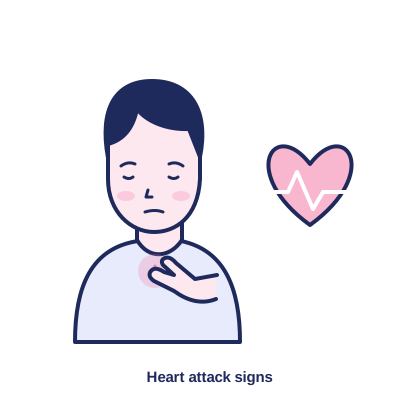
Chest pain is common, but heart attacks can also show up as shortness of breath, sweating, nausea, or pain that spreads elsewhere.
A heart attack does not always feel like a crushing chest pain. Some people feel pressure, squeezing, fullness, or pain in the center or left side of the chest. The feeling may last more than a few minutes, or it may come and go. Some people describe it as heartburn or indigestion instead of chest pain.
Other warning signs include shortness of breath, nausea, vomiting, dizziness, lightheadedness, and a cold sweat. Pain or discomfort can spread to one or both arms, the back, shoulders, neck, jaw, throat, or upper stomach. For some people, shortness of breath is the main symptom.
Symptoms can be mild at first and still be serious. They can start slowly, stop, and return. That is one reason a short-lived spell of chest discomfort or upper-body discomfort should not be brushed off if it does not have a clear explanation.
- Shortness of breath can be the only symptom.
- Pain may spread to the arm, back, jaw, neck, or upper belly.
- Symptoms may be mild, come and go, or feel like indigestion.
05 · Heart Attack
Why heart attacks can be missed in women
Women can have the usual chest pain, but they may also have symptoms that look like fatigue, indigestion, nausea, or back and jaw pain.
Heart disease is the leading cause of death in women in the United States, and women are often not diagnosed as quickly as men. One reason is that women may have symptoms that are easier to dismiss, either by the patient or by the people around them.
Women can have chest pain, pressure, or tightness during a heart attack, but they are also more likely to report unusual fatigue, indigestion, heartburn, nausea, vomiting, stomach pain, shortness of breath, back pain, or pain in the neck, jaw, or throat. Some women have symptoms during rest or routine activities instead of during exercise.
That does not mean women need a separate rule for what counts as urgent. It means new, unexplained symptoms should be taken seriously even when they do not match the classic movie version of a heart attack.
- Fatigue and indigestion-like symptoms can matter.
- Women may have symptoms at rest or during routine activity.
- Chest pain is still a warning sign and should not be ignored.
06 · Heart Attack
What to do before the hospital can help
If you think a heart attack may be happening, call 911 first. That is faster and safer than trying to drive yourself.
Call 911 if symptoms suggest a heart attack, even if you are not sure. Emergency medical services can start treatment as soon as they arrive, which can save time. Driving yourself is a bad choice if symptoms are strong, worsening, or making you faint, weak, or short of breath.
If the person is unresponsive and not breathing normally, start CPR if you can and use an AED if one is nearby. In sudden cardiac arrest, every minute matters because blood is no longer reaching the brain and other vital organs.
Do not wait for symptoms to become severe. A heart attack can come and go early on, and that does not mean it is safe to ignore.
- Call 911 even if you are unsure.
- Do not drive yourself if symptoms are serious or worsening.
- Use CPR and an AED for collapse or no normal breathing.
07 · Heart Attack
How doctors figure out what is going on
A heart attack is diagnosed by combining symptoms, ECG results, blood tests, and sometimes imaging or procedures.
In the hospital, clinicians usually start with the symptoms and an ECG, then check blood tests that look for heart muscle injury. Troponin is one of those blood tests. It can rise when the heart muscle is injured, but it does not explain the cause by itself.
No single test always proves a heart attack on its own. Doctors look at the full picture, because symptoms, ECG changes, and blood tests need to be interpreted together. In some cases, treatment starts before every result is back if the early signs are concerning.
That is why it is important to go to the hospital quickly instead of waiting at home for symptoms to settle. The team can act sooner when they see the person during the event rather than after the window has passed.
- Troponin helps, but it is not a stand-alone answer.
- ECG and blood tests are often used together.
- Treatment may begin before all test results are back.
08 · Heart Attack
Treatment aims to reopen the artery
Hospital care may include medicines, oxygen, angioplasty, or bypass surgery, depending on how the blockage looks and how serious the event is.
Treatment can include medicines that help prevent clot growth and support the heart. Oxygen may be given when needed. Some people need angioplasty, also called coronary angioplasty or PCI, to open the blocked artery. Others may need coronary artery bypass surgery if the blockage pattern is more complex.
The exact treatment depends on the type of heart attack, how long symptoms have been going on, and the person's overall health. The goal is to restore blood flow as quickly as possible and reduce heart damage.
After the emergency phase, treatment does not end. Follow-up may include cardiac rehabilitation, medicine changes, and a plan for lowering the chance of another heart attack.
- Angioplasty opens the artery in many cases.
- Some people need bypass surgery instead.
- Recovery plans usually continue after discharge.
09 · Heart Attack
What recovery can involve after discharge
After a heart attack, follow-up care often focuses on medicines, rehab, and lowering the chance of another event.
People who have had a heart attack often need close follow-up. That can include medicines, cardiac rehabilitation, and lifestyle changes such as quitting smoking, staying active, and working on blood pressure, cholesterol, and diabetes control. These steps matter because a past heart attack raises the risk of another one.
Recovery also includes practical questions. A person may need guidance on when it is safe to return to work, exercise, travel, or sexual activity. Those decisions depend on how much heart damage occurred, what treatment was needed, and how the person is healing.
If chest pain, shortness of breath, or faintness returns after discharge, that is not something to wait out. New or worsening symptoms need urgent medical attention.
- Cardiac rehab can help with a safe return to activity.
- Medicines and lifestyle changes both matter.
- New chest pain after discharge needs urgent attention.
10 · Heart Attack
What raises risk, and what can lower it
Some risks cannot be changed, but smoking, blood pressure, cholesterol, diabetes, inactivity, and stress can be addressed.
Some heart attack risk factors can be changed. These include smoking, high cholesterol, high blood pressure, diabetes, inactivity, obesity, and stress. Managing these issues can lower risk. Some factors cannot be changed, including age, sex, family history, and race or ethnicity.
Women also have some risk patterns that deserve attention, such as problems during pregnancy, menopause-related changes, endometriosis, polycystic ovary syndrome, inflammatory or autoimmune diseases, and certain types of heart disease that are harder to diagnose.
Risk reduction is still useful after a heart attack. If someone has already had one event, lowering risk matters because the chance of another event is higher.
- Smoking, blood pressure, cholesterol, diabetes, and inactivity can be addressed.
- Family history and age cannot be changed.
- Prevention matters even after a heart attack has happened.
11 · FAQ
Questions people ask
Can a heart attack happen without chest pain?
Yes. Some people mainly have shortness of breath, nausea, sweating, fatigue, back pain, jaw pain, or upper belly discomfort. Chest pain is common, but it is not required for a heart attack to be serious.
Does indigestion ever mean a heart attack?
It can. Heart attacks may feel like heartburn, indigestion, or upper belly discomfort, especially if the feeling is new, unusual, or comes with sweating, shortness of breath, nausea, or pain spreading elsewhere.
What is troponin?
Troponin is a blood protein that can rise when heart muscle is injured. A high result needs clinical context, because doctors use it along with symptoms and ECG findings to decide what is happening.
Can a person have a heart attack and still talk or walk?
Yes. Some people stay awake, talk, or even keep moving while having a heart attack. Being able to function does not make the situation safe, especially if symptoms suggest reduced blood flow to the heart.
What should I expect after leaving the hospital?
Most people need follow-up for medicines, rehab, and risk-factor control. Ask when it is safe to return to work, exercise, travel, and sex, and get urgent care right away if chest pain or shortness of breath comes back.
Can anxiety or panic feel like a heart attack?
Yes, symptoms can overlap, which is why it is not safe to assume it is only anxiety if there is chest pressure, shortness of breath, sweating, or pain spreading to the arm, jaw, or back. If heart-related symptoms are possible, emergency evaluation is the safer choice.
12 · References
References and supporting evidence
These sources support the points identified below. Source checking is not clinical approval.
- S1: Heart AttackMedlinePlus / U.S. National Library of Medicine
Explains that a heart attack is caused by blocked blood flow and loss of oxygen to the heart muscle.
- S2: Heart Disease in WomenMedlinePlus / U.S. National Library of Medicine
Explains that women may have less obvious or missed heart disease, which helps support the section on less typical symptoms and delayed recognition.
- S3: Sudden Cardiac ArrestMedlinePlus / U.S. National Library of Medicine
Explains the difference between sudden cardiac arrest and heart attack and supports the emergency CPR/AED guidance for collapse.
General information, not a diagnosis. This guide is not a substitute for care from a qualified healthcare professional. For an emergency, call 911 in the US or your local emergency number. Illustrations are conceptual and are not diagnostic images.