
01 · Overview
The short version
Congestion is a symptom, not a diagnosis
A stuffy nose can happen when the lining of the nose swells, when mucus builds up, or both. Colds and sinusitis are common causes, but irritation from dry air or other triggers can also play a role.
The timing gives useful clues
A cold often comes with sneezing, runny nose, sore throat, and symptoms that fade over 10 to 14 days. Sinus inflammation is more likely when congestion lasts longer, returns often, or comes with face pressure and postnasal drip.
Saline can help, but some sprays can backfire
Saline nose drops, sprays, and rinses may loosen mucus. Some decongestant sprays work fast at first, but frequent use can cause rebound congestion, which makes the nose feel even more blocked.
Breathing trouble and severe illness need urgent care
Call for emergency help if congestion comes with severe trouble breathing, blue lips, chest pain, fainting, confusion, or a rapidly worsening swollen face or throat.
02 · Care guidance
When to get help
Emergency help
- Call 911 or local emergency services now if congestion comes with severe trouble breathing, blue lips, swelling of the tongue or throat, chest pain, fainting, or sudden confusion.
- Get emergency care right away for rapidly worsening facial swelling, a serious allergic reaction, or a very ill appearance that is getting worse quickly.
Get advice promptly
- Contact a clinician soon if congestion lasts more than 10 days without improving, keeps coming back, or improves and then worsens again.
- Make an appointment soon if you have fever, face pain, bad-smelling drainage, frequent nosebleeds, or congestion that is making asthma or another lung condition harder to control.
- Get medical advice if congestion started after a new medicine or if one side of your nose stays blocked more than the other.
For mild congestion, rest, fluids, humidified air, saline spray, or saline rinse may help, along with avoiding smoke and strong odors. If congestion is frequent, a clinician can help sort out whether the cause is a cold, sinusitis, irritation, a medicine effect, or another problem.
03 · Nasal Congestion
What a stuffy nose is really telling you
Nasal congestion happens when the nose is swollen, filled with mucus, or both.
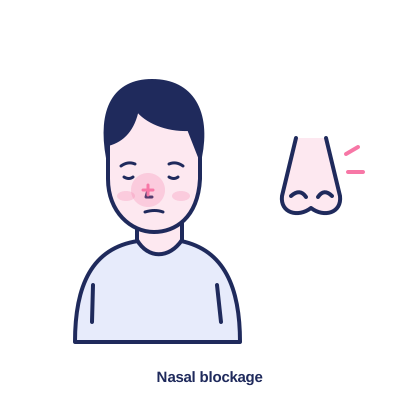
Nasal congestion is the blocked, stuffy feeling that makes it harder to breathe through your nose. It may happen with sneezing, runny nose, postnasal drip, reduced smell, or mouth breathing. The feeling itself does not explain the cause.
A cold is one common reason. Sinusitis is another. A swollen nose can also trap mucus and make the sinuses drain poorly, which adds pressure and more blockage.
- Short-term congestion often fits a cold.
- Face pressure, fever, or postnasal drip can point toward sinusitis.
- The same symptom can look different depending on what is causing the swelling.
04 · Nasal Congestion
Clues that point to a cold, sinusitis, or something else
How long congestion lasts and what comes with it gives the best clue to the cause.
A common cold often causes sneezing, stuffy nose, runny nose, sore throat, and cough. Symptoms usually start a few days after infection and can last 10 to 14 days. That makes a short, self-limited illness more likely.
Sinusitis means the sinuses are inflamed. It may start after a cold, but it can also be linked to allergies, nasal problems, or certain diseases. Fever, weakness, fatigue, cough, congestion, and postnasal drip can happen with sinusitis.
- Cold: often shorter and includes sore throat or cough.
- Sinusitis: more likely when congestion is persistent or recurrent.
- Postnasal drip and face pressure can fit sinus inflammation.
05 · Nasal Congestion
Home steps that can make breathing easier
Simple care can ease irritation while the cause runs its course.
Rest, drinking plenty of fluids, a clean humidifier or cool mist vaporizer, warm salt-water gargles, and saline nose drops or sprays can all help some people feel better while a cold improves on its own.
It also helps to avoid smoke and strong odors, which can irritate the nose and make swelling worse. If your room air is very dry, humidified air may make mucus less thick and easier to clear.
- Keep fluids up so mucus does not become thicker.
- Use a clean humidifier or cool mist vaporizer.
- Avoid smoke, vaping, and strong chemical smells.
06 · Nasal Congestion
Sprays and rinses: helpful tools, but not all the same
Saline is gentle; decongestant sprays can cause rebound if used too often.
Saline sprays and rinses can loosen mucus and help wash out the nose. They do not treat the cause by themselves, but they can make breathing more comfortable.
Some decongestant nasal sprays work quickly, but frequent or prolonged use can lead to rebound congestion. That means the nose becomes more blocked when the spray wears off, which can trap people in a cycle of repeated use.
- Saline can be used to loosen mucus and rinse the nose.
- Decongestant sprays should not be used too often or too long.
- If a spray seems necessary just to breathe, ask for advice before continuing it.
07 · Nasal Congestion
When congestion should be examined
Persistent, one-sided, or worsening symptoms deserve a closer look.
Most congestion from a cold gets better on its own. Medical evaluation becomes more important when symptoms last more than 10 days without improving, improve and then get worse again, or keep returning.
A clinician may ask about fever, face pain, drainage, breathing trouble, sleep problems, one-sided blockage, and new medicines. That visit matters because the treatment changes depending on whether the cause is a cold, sinusitis, a medicine effect, or a structural problem.
- More than 10 days without improvement should be checked.
- Better-then-worse symptoms can fit sinus inflammation.
- One-sided blockage or a new medicine side effect should not be ignored.
08 · FAQ
Questions people ask
Does yellow or green mucus mean I need antibiotics?
No. Mucus color by itself does not prove a bacterial infection. A cold or sinus inflammation can still cause colored drainage. What matters more is the full pattern, such as how long symptoms last, whether they improve and then worsen, and whether you also have fever or face pain.
Why is my nose blocked more at night?
Lying down can make swelling and drainage feel worse, so congestion may seem stronger at night. Dry bedroom air, smoke exposure, and sinus inflammation can also add to it. If poor sleep keeps happening, or if you snore loudly or wake up gasping, it is worth getting checked.
Should I use a humidifier for congestion?
A clean humidifier or cool mist vaporizer can help some people feel less dry and congested, especially in dry air. It should be cleaned as directed, because dirty equipment can become a problem of its own. If humidity seems to worsen symptoms, stop and reassess the setup.
What should I tell a clinician if I go in for this?
Bring a list of your medicines, including over-the-counter products, and be ready to describe how long the congestion has lasted, whether it is one-sided, whether you have fever or face pain, and whether symptoms improve and then return. Those details help narrow the cause.
Can a cold lead to sinusitis?
Yes. The sinusitis page notes that acute sinusitis often starts as a cold and then becomes inflamed, and it can also be linked to allergies, nasal problems, or certain diseases. If your cold-like symptoms are not improving as expected, that is one reason to get checked.
09 · References
References and supporting evidence
These sources support the points identified below. Source checking is not clinical approval.
- S1: Common ColdMedlinePlus / U.S. National Library of Medicine
Explains that a cold can cause congestion along with sneezing, runny nose, sore throat, cough, and headache. Explains the usual time course of a cold, including that symptoms can last about 10 to 14 days. Explains that saline nose drops or sprays are a treatment option for cold symptoms. Explains the need for medical evaluation when breathing trouble occurs, symptoms last more than 10 days without improving, or symptoms improve and then worsen.
- S3: SinusitisMedlinePlus / U.S. National Library of Medicine
Explains that sinusitis is inflammation of the sinuses and can have infectious or noninfectious causes. Explains common sinusitis symptoms, including congestion and postnasal drip. Explains that saline nasal sprays and vaporizers may help with sinusitis symptoms.
General information, not a diagnosis. This guide is not a substitute for care from a qualified healthcare professional. For an emergency, call 911 in the US or your local emergency number. Illustrations are conceptual and are not diagnostic images.