
01 · Overview
The short version
The same spot can mean different problems
Pain under the ribs or in the upper middle belly can come from the stomach, pancreas, gallbladder, liver, esophagus, or nearby muscles.
Meals and body position can be clues
Pain after eating can fit reflux, gallbladder trouble, or pancreatitis, but it does not identify one diagnosis by itself.
Vomiting, jaundice, or breathing trouble changes the urgency
Upper abdominal pain with repeated vomiting, yellow skin or eyes, fainting, chest pressure, or trouble breathing needs faster medical attention.
Pregnancy changes the warning signs
Upper right abdominal pain during pregnancy can be a sign of preeclampsia, especially when it happens with headache, vision changes, swelling, or shortness of breath.
02 · Care guidance
When to get help
Emergency help
- Call 911 or local emergency services now if upper abdominal pain comes with chest pressure, trouble breathing, fainting, confusion, severe weakness, vomiting blood, black stools, a rigid abdomen, or signs of shock.
- If you are pregnant and have upper abdominal pain with severe headache, vision changes, swelling, shortness of breath, or seizure, get emergency care right away.
Get advice promptly
- Contact a clinician promptly if the pain is severe, lasts more than a few hours, keeps returning, happens after fatty meals, spreads to the back or right shoulder, or is paired with fever, jaundice, or ongoing nausea and vomiting.
- Seek prompt care if you may have pancreatitis, gallbladder disease, liver problems, or frequent or worsening reflux symptoms.
If the pain is mild, short-lived, and you otherwise feel well, arrange a routine visit. The visit is useful for sorting out triggers, reviewing medicines, checking the abdomen, and deciding whether blood tests or imaging are needed.
03 · Upper Abdominal Pain
What doctors mean by upper abdominal pain
Upper abdominal pain is a symptom, not a diagnosis.
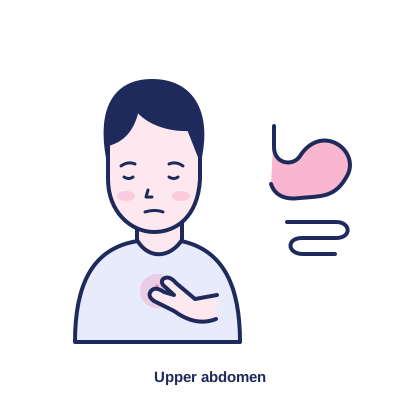
The upper abdomen is the area below the ribs and above the belly button. Pain there can come from the stomach or esophagus, but also from nearby organs such as the gallbladder, liver, and pancreas. Muscle strain or rib irritation can also be felt in the same area.
That overlap is why doctors ask about timing, meal triggers, nausea, vomiting, fever, bowel changes, and whether the pain stays in one place or moves to the back or shoulder. Those details are often more useful than the exact spot alone.
A burning feeling may fit reflux or stomach irritation, but it does not rule out other causes. Sharp pain, pressure, or cramping can also be misleading, so the pattern matters more than the word used to describe it.
- Pain that follows meals can point toward a digestive trigger, but not one single cause.
- Pain that spreads to the back, shoulder, or chest deserves more attention.
- Symptoms such as fever, vomiting, or jaundice change how urgent the problem may be.
04 · Upper Abdominal Pain
Upper right pain after meals: gallbladder is one possibility
Pain after a meal can happen with gallbladder problems, but the pattern is not specific enough to diagnose on its own.
Gallstones can cause upper right abdominal pain, and the pain may show up after eating, especially after a fatty meal. Some people also notice nausea or vomiting. The pain may spread to the back or right shoulder.
That pattern is important, but it is not unique to the gallbladder. Reflux, pancreatitis, and liver or bile duct problems can overlap with it. If pain is strong, keeps coming back, or is paired with fever or yellow skin or eyes, it deserves prompt evaluation because a blocked or infected bile duct can become serious.
A clinician may ask when the pain starts, whether it follows meals, and whether you have had gallstones before. If the exam suggests a bile duct problem, blood tests or imaging may be used to sort out whether the gallbladder, liver, or pancreas is involved.
- After-meal upper right pain is a clue, not a diagnosis.
- Fever or jaundice makes the concern more urgent.
- Pain that reaches the back or right shoulder can help narrow the cause.
05 · Upper Abdominal Pain
When severe upper pain suggests pancreatitis
Pancreatitis often causes strong upper abdominal pain with nausea and vomiting, and it can be serious.
Pancreatitis is inflammation of the pancreas. Acute pancreatitis starts suddenly and often causes severe pain in the upper abdomen, along with nausea and vomiting. The pain can reach the back. Chronic pancreatitis is different because it causes ongoing damage over time and can lead to weight loss and oily stools.
Gallstones are a common cause of acute pancreatitis. Heavy alcohol use is the most common cause of chronic pancreatitis. Other causes include some medicines, high levels of fats or calcium in the blood, inherited disorders, and autoimmune conditions.
Because pancreatitis can become serious, severe pain with repeated vomiting should not be treated as a simple stomach bug. People with this pattern usually need medical assessment, and some need hospital care for fluids, pain control, and monitoring.
- Severe, steady pain is more concerning than brief cramping.
- Pain that reaches the back is a classic clue to ask about.
- Repeated vomiting can quickly lead to dehydration.
06 · Upper Abdominal Pain
Burning, sour, or worse when lying down: reflux can do this
Reflux can cause upper stomach or chest burning, but frequent symptoms should be checked.
Reflux happens when stomach contents flow back into the esophagus. It can cause heartburn, a burning feeling in the chest or throat, nausea, and sometimes upper stomach discomfort. Symptoms may be worse after meals, when lying down, or when bending over.
Reflux can be felt as upper abdominal pain instead of classic heartburn. It can also be confused with other causes of upper belly pain, which is why repeated symptoms should not be brushed off as simple indigestion.
If symptoms happen often, disturb sleep, or make eating difficult, a clinician may consider changes in eating habits, medicine to reduce stomach acid, or testing for other causes such as an ulcer-like problem. Reflux itself usually does not cause jaundice or high fever.
- Worse when lying down is a common reflux clue.
- Sour taste, burping, or throat irritation can support the pattern.
- Frequent symptoms deserve evaluation rather than repeated self-treatment.
07 · Upper Abdominal Pain
Right-sided pain with jaundice points to a different problem
Upper right pain plus jaundice, dark urine, pale stools, or fever can point to liver or bile duct disease.
The liver does not always cause obvious pain, but swelling or irritation around it can. Problems in the bile ducts can also cause pain in the upper right abdomen. Yellow skin or eyes, dark urine, pale stools, itching, or fever are important clues that the liver or bile system may be involved.
These symptoms need attention because they can signal blockage or inflammation, not just simple stomach upset. Some liver problems cause little pain early on, so a mild ache does not rule them out.
Clinicians often use blood tests and sometimes imaging to separate liver, gallbladder, pancreas, and bile duct causes. The goal is not to guess from the location alone, but to match the symptoms with the right test.
- Jaundice is not normal and should not be watched for long at home.
- Fever plus right-sided pain raises concern for infection or blockage.
- Pain alone may be mild even when a liver or bile problem is present.
08 · Upper Abdominal Pain
Upper abdominal pain in pregnancy needs a lower threshold for care
Upper right pain during pregnancy can be a warning sign of preeclampsia.
During pregnancy, upper right abdominal pain should not be written off as normal discomfort if it comes with headache, vision changes, swelling in the face or hands, shortness of breath, or high blood pressure. Preeclampsia can affect the liver and other organs and can become serious quickly.
Pregnancy changes how the abdomen feels, so not every ache is dangerous. Still, new upper abdominal pain after 20 weeks of pregnancy, or pain with the warning signs above, should be reported without delay.
In rare cases, preeclampsia can continue after delivery, so postpartum symptoms matter too. The safer approach is to treat new upper abdominal pain in pregnancy as something that deserves prompt assessment.
- Headache and vision changes are especially important warning signs.
- Swelling and shortness of breath add to the concern.
- Postpartum symptoms can still be related to preeclampsia.
09 · Upper Abdominal Pain
Other problems that can feel like stomach pain
Gas, muscle strain, and rib or chest wall pain can mimic upper abdominal pain, but they should not be assumed.
Upper abdominal pain does not always come from an internal organ. Tight muscles, rib irritation, or diaphragm-related pain can be felt under the ribs and may change with movement, twisting, coughing, or pressing on the area. Reflux and gas can also create pressure that feels high in the abdomen.
A pattern that changes with position or movement may point more toward the chest wall or muscles. Pain tied to meals, nausea, vomiting, or burning is more likely to involve the digestive tract. Even then, the pattern is not exact enough to diagnose without an exam.
If the pain keeps coming back, changes over time, or starts to affect eating or sleeping, a clinician can help sort out whether the source is more likely the stomach, gallbladder, pancreas, liver, or something outside the abdomen.
- Movement-related pain is often different from deep organ pain.
- Gas can cause pressure, but severe pain still needs evaluation.
- A normal-looking day does not always rule out a real medical problem.
10 · FAQ
Questions people ask
Is upper abdominal pain usually from gas?
Sometimes, but not always. Gas can cause pressure or cramping in the upper belly, yet the same area can also hurt from reflux, gallbladder disease, pancreatitis, liver problems, or even chest wall pain. If the pain is severe, keeps returning, or comes with fever, vomiting, jaundice, chest pressure, or trouble breathing, do not assume it is just gas.
Can upper abdominal pain come from a stomach ulcer?
It can, but the supplied evidence does not describe ulcers in detail. That means an ulcer is only one possibility a clinician might consider, especially when pain is burning or linked to meals. The important part is not to self-diagnose if the pain is ongoing, getting worse, or paired with vomiting, black stools, or fainting.
What should I do while I wait for an appointment?
If symptoms are mild and you are otherwise well, keep track of when the pain starts, what you ate, whether lying down or movement changes it, and any fever, nausea, vomiting, or bowel changes. Avoid alcohol if pancreatitis or liver disease is possible. If the pain becomes severe, persistent, or comes with warning signs, seek urgent care instead of waiting.
Could upper abdominal pain be from my liver even if it is not very painful?
Yes. Some liver or bile duct problems cause only mild pain or discomfort at first, so the rest of the symptoms matter too. Yellow skin or eyes, dark urine, pale stools, itching, or fever raise concern and should be checked quickly. Pain alone does not tell the full story.
How does a clinician usually figure out the cause?
The visit usually starts with questions about timing, food triggers, the exact pain pattern, and symptoms like nausea, vomiting, fever, chest pain, jaundice, or pregnancy. Depending on what they find, they may order blood tests, urine tests, or imaging such as an ultrasound. Those steps help separate gallbladder, pancreas, liver, reflux, and other causes.
If the pain is on the right side, is it always the gallbladder?
No. Right-sided upper abdominal pain can come from the gallbladder, liver, bile ducts, stomach, pancreas, reflux, or even the muscles and ribs. The timing, whether you feel sick, and whether the pain spreads to the back or shoulder are all part of the picture. Repeated right-sided pain deserves a medical check rather than a guess.
11 · References
References and supporting evidence
These sources support the points identified below. Source checking is not clinical approval.
- S1: PancreatitisMedlinePlus / U.S. National Library of Medicine
Explains that pancreatitis is a pancreas problem, can start suddenly, and is often related to gallstones. Supports the description of pancreatitis symptoms and the warning that severe upper abdominal pain with vomiting is concerning.
- S2: High Blood Pressure in PregnancyMedlinePlus / U.S. National Library of Medicine
Supports pregnancy warning signs that make upper right abdominal pain more urgent, especially headache, vision changes, swelling, and trouble breathing. Supports the need for urgent care when pregnancy symptoms suggest preeclampsia.
- S3: Reflux in ChildrenMedlinePlus / U.S. National Library of Medicine
Explains the mechanism of reflux and why it can cause upper chest or upper stomach discomfort. Supports the idea that reflux symptoms can be felt in different ways and are not limited to classic heartburn. Supports the recommendation to seek evaluation for frequent or disruptive reflux-like symptoms rather than assuming the cause.
General information, not a diagnosis. This guide is not a substitute for care from a qualified healthcare professional. For an emergency, call 911 in the US or your local emergency number. Illustrations are conceptual and are not diagnostic images.